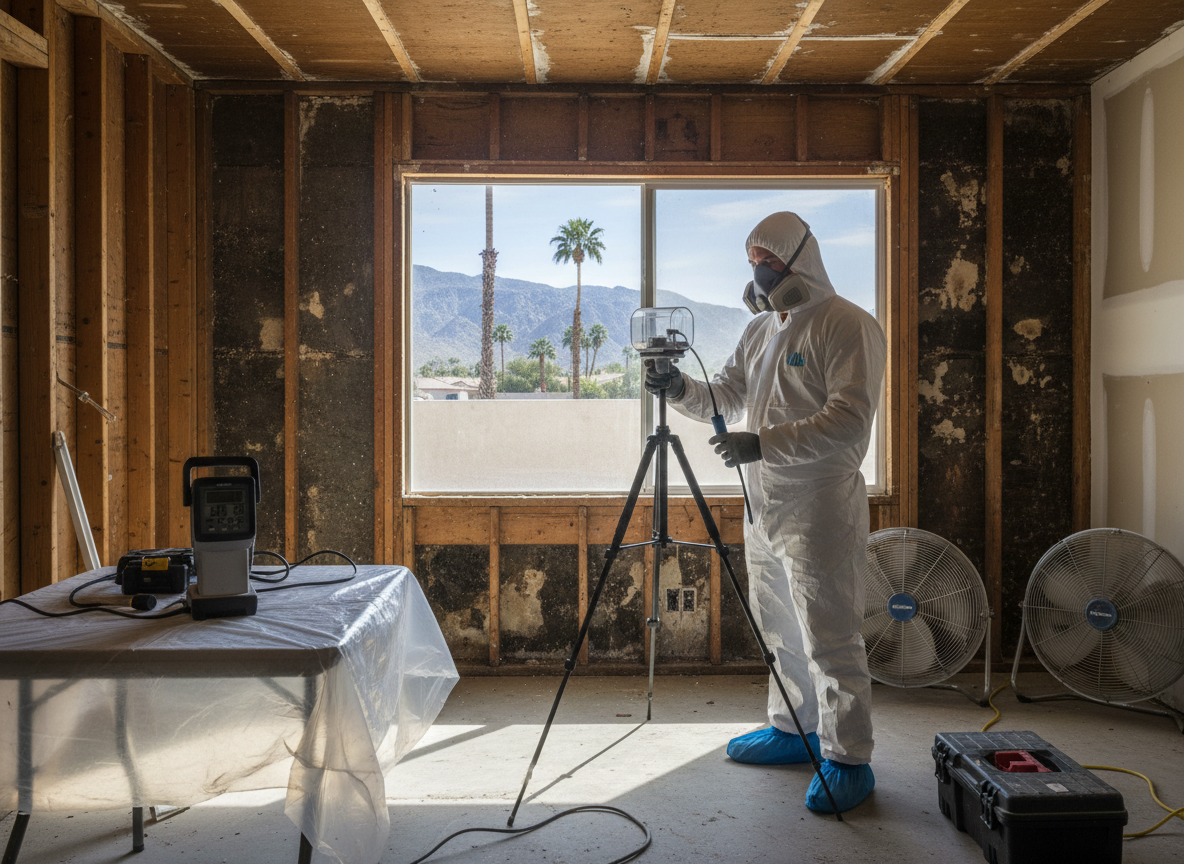
Thousand Palms sits in a hot desert climate where constant air conditioning use in Riverside County homes circulates spores through older ductwork and evaporative coolers common in neighborhoods surrounding the Coachella Valley Preserve. Many single-story stucco houses built from the 1970s onward have flat roofs and minimal attic ventilation, allowing condensation to form during rare monsoon moisture events even when outdoor humidity stays low. Testing must account for these patterns because visible growth often hides inside wall cavities or behind HVAC filters rather than on open surfaces.
Air sampling protocols here include both indoor and outdoor baseline comparisons to distinguish desert dust from actual mold amplification. Technicians pull samples from multiple zones, including supply registers and return plenums, because the dry climate masks musty odors until spore counts rise sharply. Surface tape lifts and bulk material collection from insulation or drywall become necessary when residents report allergy spikes after Palm Desert wind events push fine particles through unsealed building envelopes.
Code considerations in Riverside County require documentation of moisture sources before any remediation plan, especially near the preserve where protected land limits drainage options. Homeowners often overlook how irrigation runoff from golf course communities along Country Club Drive can seep into slab foundations, creating hidden pockets that standard visual checks miss. Proper testing identifies these conditions early and prevents unnecessary whole-house treatments.
Technician insight
In Thousand Palms, the thing that catches most people out with Air quality and mold testing is how the constant AC use in 1970s-1990s stucco homes pushes spores through poorly sealed ducts long before any visible signs appear, especially after wind events from the preserve.
AC Duct Testing After Monsoon Odor
A resident near Coachella Valley Preserve noticed odors only when the AC ran following a brief storm. Testing revealed elevated spores inside the return plenum of a 1980s home. We isolated the source to a small roof leak and confirmed clearance after targeted cleaning.
How it works
- 1
Site Assessment
Walk through the Thousand Palms property to identify moisture history, HVAC layout, and high-risk zones tied to desert construction.
- 2
Sample Collection
Collect air, surface, and bulk samples from key locations including ducts and attics while recording outdoor baselines.
- 3
Laboratory Analysis
Send samples to an accredited lab for spore identification and concentration levels specific to regional desert molds.
- 4
Report and Recommendations
Deliver findings with clear explanations of results and next steps for any detected issues in Riverside County homes.
- 5
Follow-Up Testing
Return after remediation to verify air quality has returned to acceptable levels for the local climate.
Pricing
Pricing varies by property size, number of samples, and access difficulty. Upfront quotes provided after initial assessment.