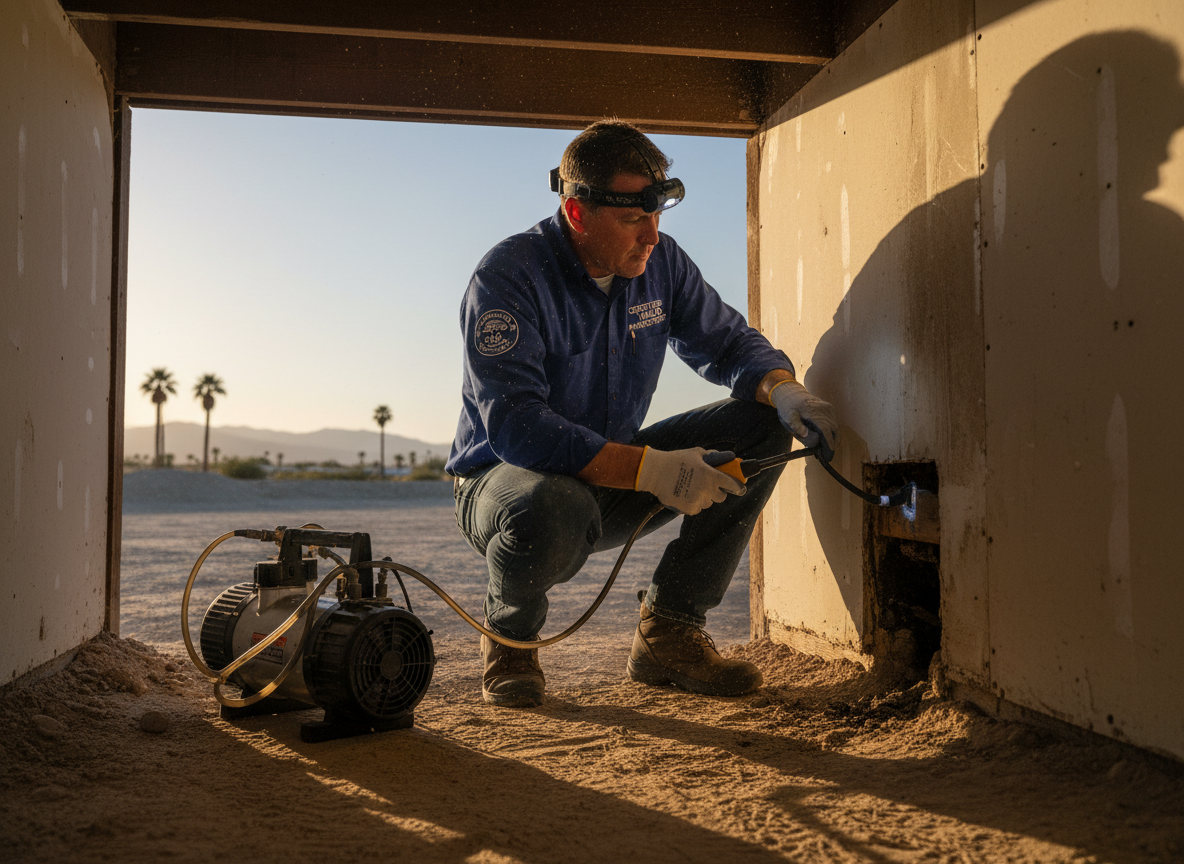
Thousand Palms sits in the hot desert climate of Riverside County where low outside humidity masks moisture problems inside homes. Most houses here are single-story tract builds from the 1970s and 1980s with flat or low-slope roofs and limited attic ventilation. Air conditioning runs year-round, and condensation inside ducts and around evaporator coils often feeds hidden mold that spreads through the system once temperatures rise. Inspectors must pull panels and use moisture meters on metal ductwork rather than relying on visible surface growth alone.
After the occasional monsoon rain, water pools against stucco walls and enters through unsealed penetrations common in older Palm Desert and Thousand Palms construction. Soil in the Coachella Valley holds little organic matter yet still supports mold when irrigation or plumbing leaks keep framing damp. A proper inspection includes checking under sinks, behind refrigerators, and along the perimeter where slab-on-grade floors meet exterior walls. Skipping these spots leaves moisture pockets that later require full remediation.
Homeowners often request inspection before listing property or after noticing musty smells near return vents. The process documents current conditions with photos and meter readings so buyers or insurers see exactly where problems exist. Because desert air dries surfaces quickly, inspectors schedule visits soon after any reported leak rather than waiting for odors to become obvious.
Technician insight
In Thousand Palms, the thing that catches most people out with certified mold inspector is how the constant AC use in 1970s tract homes pushes condensation into duct seams and attic sheathing that never fully dries between the rare rains. Homeowners check bathrooms and forget the return-air chase running through the attic.
Attic Inspection After Irrigation Leak
A homeowner near the Coachella Valley Preserve noticed a musty smell when the AC kicked on after a sprinkler line broke. Inspection found elevated moisture along ceiling joists where water had wicked under the insulation. Readings and photos documented the extent so the remediation crew could focus on the affected section without opening unnecessary walls.
How it works
- 1
Phone Assessment
Gather details on recent leaks, AC issues, or odor locations while noting the home's age and construction type in Thousand Palms.
- 2
On-Site Visual Walkthrough
Examine attics, crawl spaces, duct runs, and exterior walls using moisture meters and borescopes around common leak points.
- 3
Targeted Sampling
Collect air or surface samples only where readings indicate elevated moisture, then send to an independent lab.
- 4
Written Report Delivery
Provide findings with photos, meter data, and clear next-step recommendations within 48 hours.
Pricing
Upfront quotes provided after the initial phone assessment based on square footage and access needs.