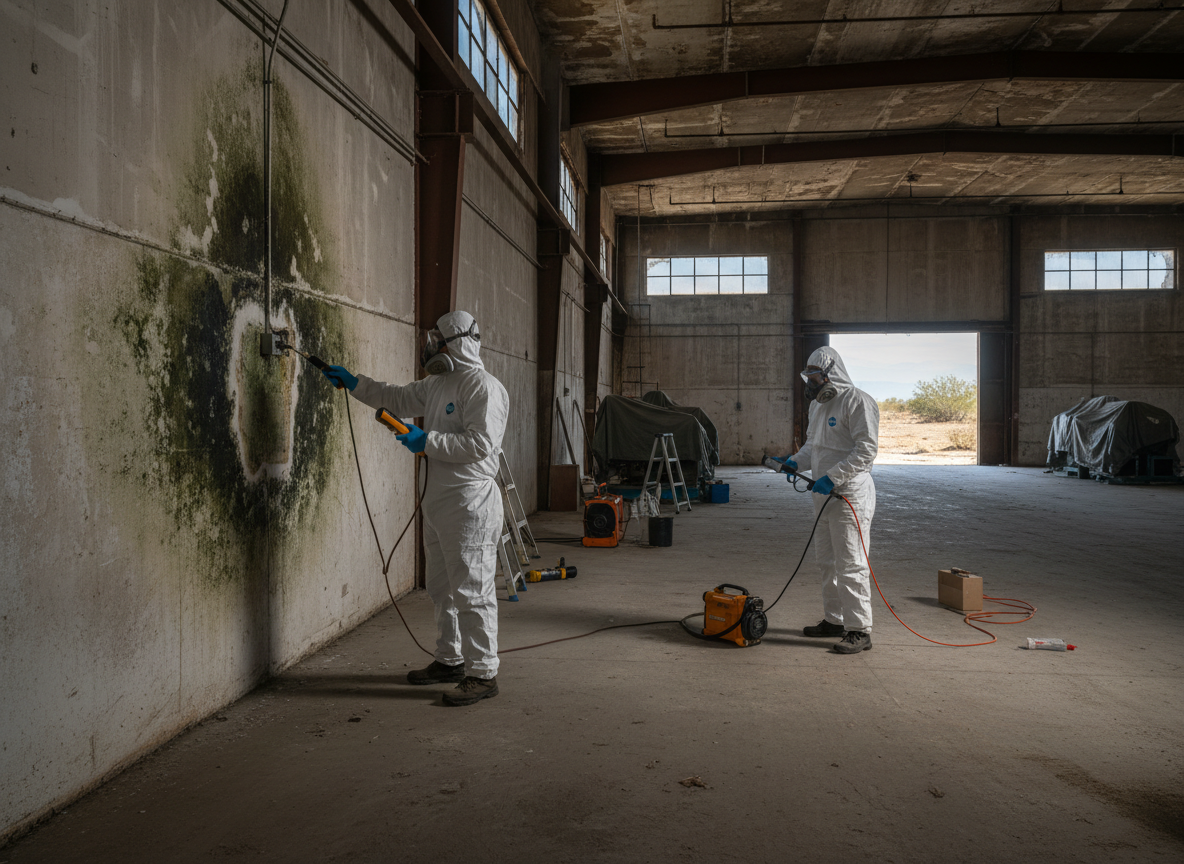
Commercial buildings in Thousand Palms often feature flat roofs and older HVAC systems that struggle with the constant cycling required by summer temperatures above 110 degrees. Condensation forms inside ductwork and wall cavities when cooled air meets hot exterior surfaces, especially in structures built before modern vapor barrier standards. Inspectors must check above suspended ceilings and along slab edges where irrigation from nearby Coachella Valley Preserve landscaping can seep inward.
Riverside County commercial codes require documentation of moisture sources before any remediation plan is approved. Air sampling alone misses surface growth on concrete block walls common in local retail and office spaces. Thermal imaging combined with pinless meters reveals temperature differentials behind stucco that signal active leaks from evaporative coolers still used in many Palm Desert-adjacent properties.
Edge cases include mold reappearing in storage rooms after monsoon humidity spikes because drainage around parking lots was never graded properly. Inspectors also evaluate tenant improvements such as added partitions that block airflow and trap moisture from restrooms or break areas. Reports must note these conditions clearly so property managers can address them before they affect multiple suites.
Technician insight
In Thousand Palms, the thing that catches most people out with Commercial mold inspection is how the desert heat forces nonstop AC use in older commercial buildings near the Coachella Valley Preserve, pushing condensation into wall cavities that only show up with thermal imaging during the hottest months.
Retail Strip Center Inspection
A property manager reported recurring musty smells in two suites after heavy seasonal rains. Inspection revealed condensation inside the shared HVAC trunk line caused by poor insulation against the exterior heat. Targeted sampling confirmed mold on duct insulation. The report outlined specific repairs to the line and drainage grading around the building foundation.
How it works
- 1
Site Walkthrough
Review building plans and walk every accessible area noting HVAC layout, past water events, and tenant complaints.
- 2
Moisture Mapping
Use meters and infrared cameras to locate hidden dampness in walls, ceilings, and under flooring.
- 3
Targeted Sampling
Collect air and surface samples from suspect zones plus control areas for lab analysis.
- 4
Findings Report
Deliver written assessment with photos, lab results, and prioritized recommendations for remediation.
Pricing
Cost depends on square footage, number of samples, and building complexity; request a scope-specific quote.